Is the more expensive one worth it? Comparing products on WhatsApp before a sale
Help Salla shoppers choose between two products: ask what matters, compare verified differences, explain when the cheaper option fits, and hand off missing facts.
Posted by
 TajirTalk Team
Related reading
Can I return it after opening? Answering pre-purchase return questions on WhatsApp
Help a Salla shopper understand the relevant return policy before buying: clarify what opened means, check the exact item, and hand off exceptions without promising a refund.
“Will this fit my device?” Answering product compatibility questions on WhatsApp
Ask for the exact model, check the selected product option, and give a supported answer before sharing a purchase link. Includes a fictional phone-case example.
What should a back-in-stock WhatsApp message say?
A practical restock checklist: match the requested product, check availability, write a useful WhatsApp alert, and avoid promises about variants or reservations.
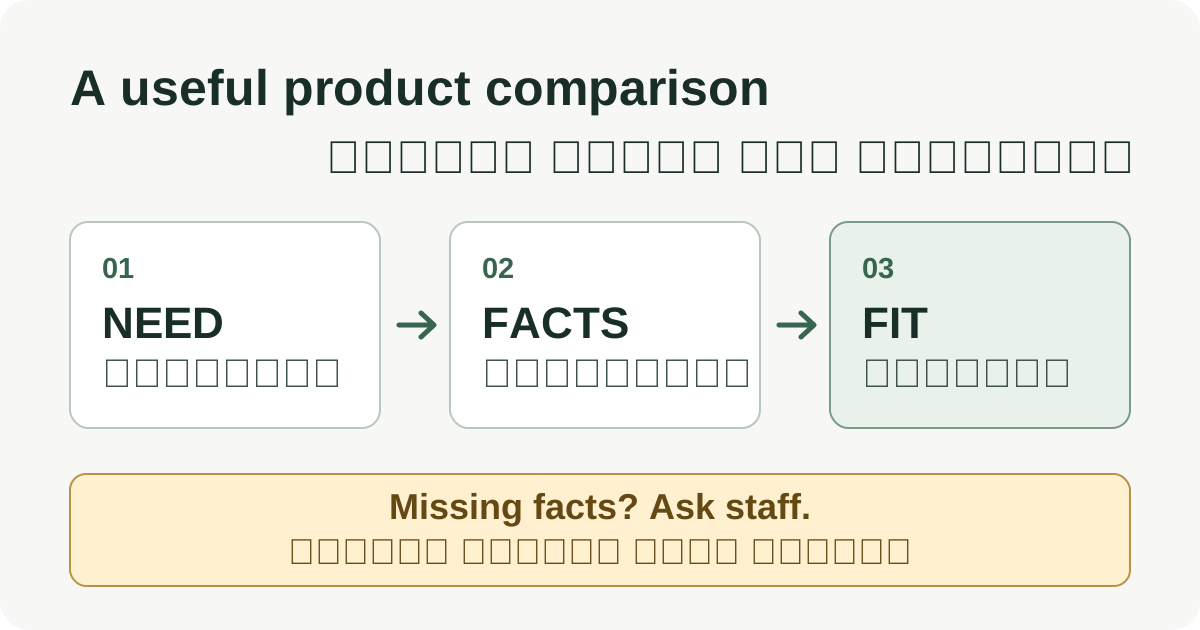
When is the higher price worth paying?
Only when a verified difference solves a need the shopper actually has. Ask what they will use the product for and their budget, compare the exact two options, and explain the relevant trade-off. If the less expensive option meets the stated need, say so. If a deciding fact is missing, ask staff before recommending either.
“Which one should I buy?” is often the last question before checkout. Sending two long descriptions back is not much help. A useful answer connects one or two clear differences to the shopper's situation, then gives them the correct product link.
Start with one question that changes the recommendation
Ask for the two product links or exact names and variants. Then ask a short question such as, “Will you mostly use it at your desk or carry it in a bag?” Add a budget question if the shopper has not given one. Avoid a questionnaire when one detail will settle the choice.
- Separate essentials from preferences: a required capacity matters more than a color preference.
- Confirm the same unit of comparison: one item versus a multipack, or the base version versus a bundle.
- Do not ask for a phone number, order number, or address to compare public product details.
If the shopper says only “the best,” ask what “best” means for them. Higher price, a premium-sounding name, or more accessories does not establish better durability, compatibility, or performance.
Compare the evidence, then explain the trade-off
| Decision point | Check for both options | Useful reply |
|---|---|---|
| The essential need | The exact published specification that answers it. | Explain which option meets the need and cite the relevant fact. |
| What costs more | Current variant price, quantity, and included items. | Name the extra feature or quantity; do not invent a reason for the price. |
| What the buyer gives up | A documented difference in size, capacity, or another relevant property. | Explain the trade-off without calling one option better in every way. |
| What is unknown | Missing, conflicting, or out-of-date details. | State the gap and ask staff instead of converting uncertainty into a claim. |
Compare prices on the same basis and do not assume that a listed product price is the delivered total. Shipping, selected options, and any applicable checkout charges must be checked where the store shows them. Link the exact option and ask the shopper to confirm the current price and availability before paying.
Use a simple reply structure: “For your stated use, I would choose [option] because [verified fact]. Choose [other option] if [different priority]. Here are the exact links.” Remove any part you cannot support. Do not add “last one,” a discount, or a delivery promise to create urgency.
Fictional example: two travel cups and a missing fact
This is a made-up comparison exercise, not a customer conversation, an actual product listing, or a TajirTalk recommendation.
Shopper: “Is the larger, more expensive cup worth it? I carry it in my work bag and want at least 400 ml.”
Available facts: The smaller cup is 350 ml; the larger one is 500 ml. Neither source says whether its lid prevents leaks when carried in a bag.
Useful reply: “The 500 ml cup meets your capacity requirement; the 350 ml one does not. I cannot confirm from the listed details that either is suitable for carrying in a bag without leaking. I will ask our team to check that point before recommending one for your commute.”
The extra capacity is a verified difference. Leak resistance is still unknown. A confident answer about capacity must not turn into an unsupported promise about carrying the cup.
Prepare your Salla catalog and TajirTalk answers
TajirTalk's product-answer flow uses store product search rather than asking the AI to invent catalog facts. For your Salla store, check that the relevant products, options, prices, and descriptions are available and current. Put factual differences in the product information where the search can find them; keep approved general guidance in your FAQs.
Write concise guidance for recurring choices, such as which measurements a shopper should check. Do not put changing prices or stock promises into a static comparison script. A missing catalog field will not become reliable merely because you connect the store.
Use the agent's instructions and fallback wording to set the boundaries, then test them. Review conversations and pause AI replies when staff take over. This is an answer workflow to prepare and verify, not a promise of an automatic comparison engine or a guaranteed sales lift.
Test the buying decision before enabling replies
- The cheaper option meets every stated requirement: does the answer explain that without pushing an upgrade?
- The higher-priced option has a relevant verified advantage: does it name the advantage and the trade-off?
- A key specification is missing: does it ask staff rather than infer quality from the price?
- A variant, price, or availability changes: does the answer avoid reusing the old comparison as current fact?
- The same question arrives in Arabic and English: do the product, units, limits, and next step stay consistent?
Review whether the conversation resolved the shopper's uncertainty and whether staff completed any handoff. To judge sales impact, use actual order outcomes and the attribution your store can verify. A helpful reply or product-link click alone is not a purchase.
View TajirTalk on Salla (Arabic) Review current plans and setup requirements before installing.
Related: prepare product knowledge and answer compatibility questions.
